Intern to Engineer: An Inside Look at the Diverta Global Internship
Every year, Diverta's Global Internship program offers Computer Science students from around the world a unique opportunity to kickstart their careers as software engineers in Japan.
For two months or more, international interns join us in Tokyo to work on real B2B software projects alongside a talented global team of engineers. It's a chance to gain valuable hands-on experience while exploring the culture and beauty of Japan, supported by a comprehensive benefits package that includes flights, accommodation, commute, meals, and more. Find out more about our program benefits here.
We frequently receive questions from candidates about this experience: What’s the hiring process really like? How can I succeed in this opportunity? What kind of work do you do? What is it like to live and work in Japan?
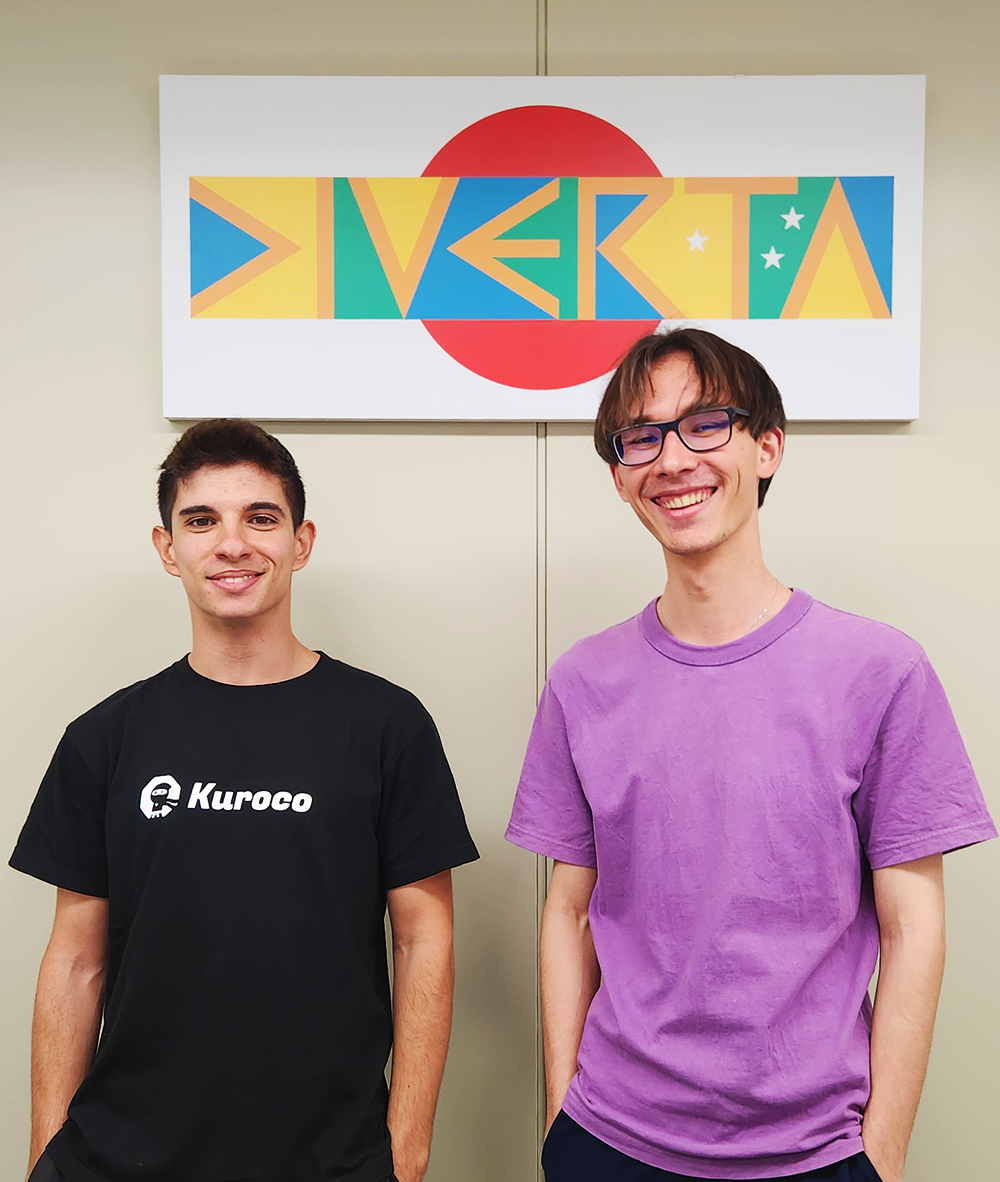
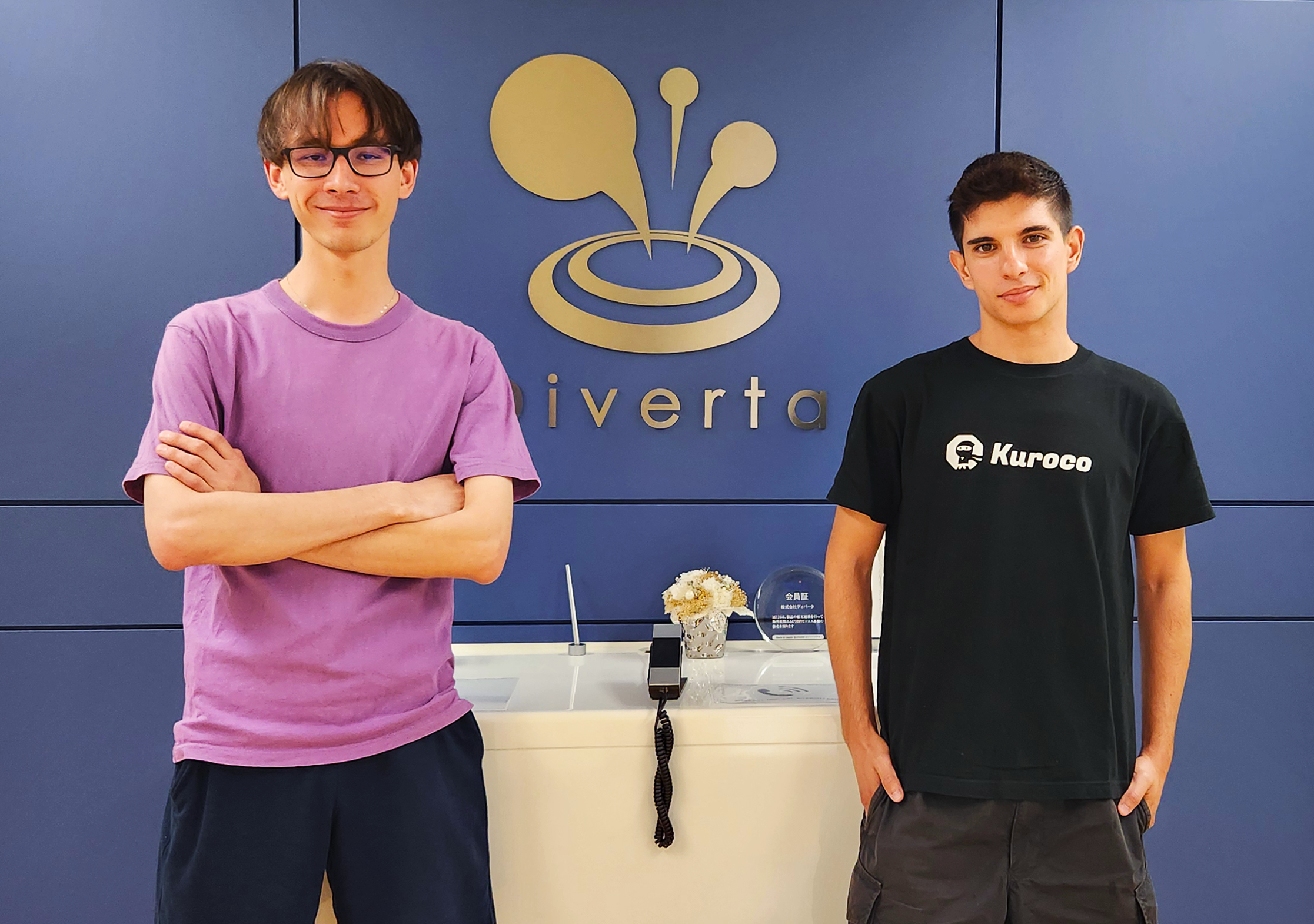
To give you a firsthand look, I sat down with the best possible sources, interns-turned-employees Damir and Danilo. Both started their careers as global interns at Diverta and soon joined us as full-time software engineers.
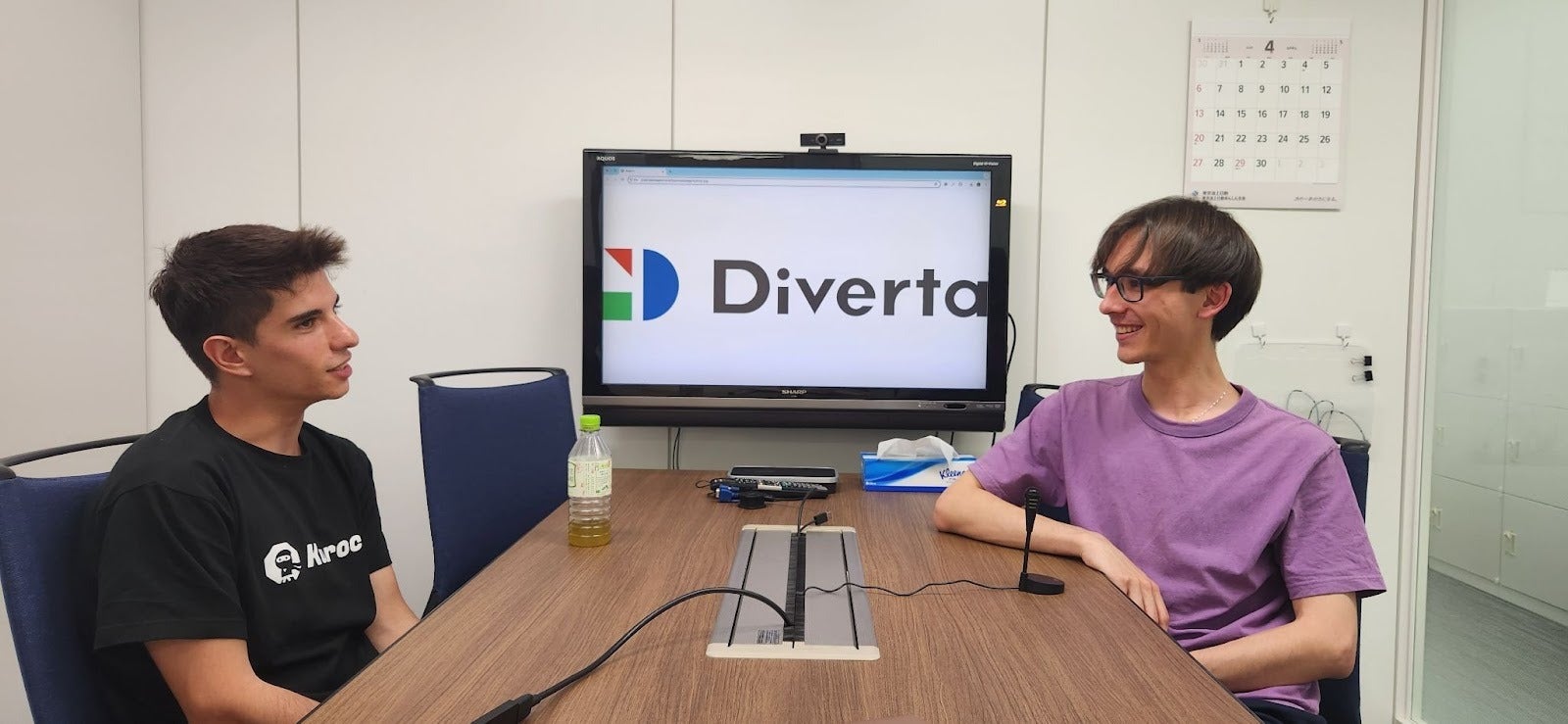
They've shared their complete journey to answer your questions and offer advice from their personal experience in this interview, conducted by Asmaa from the Human Resources team, who also manages the recruitment for the Global Internship program.
Let's begin.
Asmaa: First, could you briefly introduce yourselves and explain how you came across the Diverta Global Internship?
Damir: I am from Russia, where I lived until moving to France. There, I completed high school and preparatory classes specializing in math, physics, and computer science. Then, I pursued a Master's in computer science at an engineering school. During my search for a penultimate-year internship, I learned about the Diverta internship through a friend who had applied but was not selected. He kindly shared the opportunity with me, so I applied and completed the recruitment process successfully.
Danilo: I’m from Italy. I studied computer science and engineering at Politecnico di Milano, where I completed both my bachelor's and master's degrees. After graduating in December 2023, I began actively seeking jobs in January. I submitted 256 applications, primarily targeting opportunities outside Europe, such as in the US, Australia, Japan, and also some in Switzerland. Eventually, I came across Diverta’s job offer on Indeed, applied, and was successfully selected.
Internship Hiring Process
Asmaa: How was the hiring process, from application to arriving in Japan?
Danilo: Overall, it was quite smooth. The coding assessment wasn't too challenging, and I particularly appreciated the inclusion of a small system design question. That’s uncommon because it requires manual evaluation, unlike standard coding problems that are automatically scored. The interviews also went well, and the company fully supported me through the relocation process to Japan, organizing flights and accommodations so I didn't need to handle any logistics myself.
Asmaa: Same question for you, Damir. How was your experience with the recruitment process?
Damir: After applying, I received a response as fast as the next day, and the entire process took about two and a half weeks. I prepared a PowerPoint presentation for the interviews, but I was nervous as it was my first interview experience and my first time using English professionally. The HR interview went smoothly, and the test was straightforward, taking only about 10 to 20 minutes.
The technical interview was more challenging. I gave some wrong answers and encountered several knowledge gaps. Additionally, I became overly defensive about certain questions, almost jeopardizing my application. At the time, I didn’t realize that the purpose of the questions was to understand my reasoning and just assess what I knew by that point. The interview also significantly exceeded the scheduled time, adding extra pressure. However, after receiving the offer, the administrative tasks such as obtaining a visa and arranging travel were seamlessly managed by the company, making the process highly convenient.
At the time, I didn’t realize that the purpose of the questions was to understand my reasoning and just assess what I knew by that point.
Asmaa: What were your main motivations for accepting the internship offer?
Danilo: For me, the primary motivation was the structure of the internship itself. Spending two months in Japan was appealing because I had always wanted to visit. Additionally, this setup didn't require a major commitment; if I didn’t enjoy the work or living abroad, I could simply return home afterward. This flexibility was a big advantage compared to taking a full-time role abroad, which typically involves significant commitments like arranging accommodation. I appreciated having the opportunity to test the experience for two months first.
I was also genuinely interested in the nature of the work. Although my master’s thesis was focused on autonomous driving, I was eager to explore other areas within IT, and web development was an area I found particularly intriguing.
Asmaa: Damir, what motivated you to accept the offer?
Damir: My primary motivation at the time was practicality, Diverta’s offer aligned perfectly with my school's requirement to complete an internship abroad. My studies at the time were broad, covering various fields of computer science such as web development, cybersecurity, networking, and AI. The internship topic matched my interests well.
Additionally, the benefits played a significant role. The company’s support in covering flights and accommodation made it feasible, especially given my status as an international student in the EU. I had previously faced rejections from European companies due to visa and timing constraints, they typically preferred candidates who could join immediately without paperwork. While accepting the offer was partly driven by necessity, the overall conditions and topic were also genuinely appealing.
Internship Experience in Japan
Asmaa: What was the most interesting part of your experience living in Tokyo?
Danilo: The most interesting experience for me was coming to Japan for the first time; it was actually my first time outside of Europe. It was fascinating to live somewhere completely different after spending my whole life in Italy. The culture is so different, and I loved that difference more than I expected. In the first two weeks, I did a trip all around Japan: Kyoto, Osaka, Nara, many places, and I was completely fascinated by the country and its landscapes.
Asmaa: Arriving two weeks early to go on a trip on your own was a smart move. I would recommend that. What about your outside-of-work experience during your three-month internship in Japan, Damir?
Damir: It was great. What I appreciated most was moving around on weekends and after work. I did little trips around Tokyo and beyond. It was really refreshing, although the summer was incredibly hot, but it was a nice balance with work. We had a seven-hour workday, so it was possible to have a good work-life balance. I liked that you could just work and then conveniently travel with all the buses and trains. It’s very easy to move around and explore new places.
Tasks & Acquired Skills
Asmaa: Next, let's talk about the work. What kind of projects did you work on during the internship? What was interesting and what was challenging?
Damir: When I did my internship, the trendy product was KurocoEdge, this was before the recent AI boom. The first part of my internship involved studying the new product from a user's point of view. The task was to create a use-case example for the product. It was a creative task with complete freedom, so it was pretty interesting to build. You just had to explore the product and create something that could be a useful example for clients.
This took up the major part of the internship. In the last month, I worked on Kuroco CMS itself. There were two other interns, and we had separate tasks in the beginning that we needed to combine under an integration system in the end. It was very interesting to collaborate with the other interns and make our work function together. I think the most difficult part was discovering how the Kuroco CMS codebase works. It's not very beginner-friendly.
Asmaa: Danilo, what was your task in general, and what did you find most interesting and challenging?
Danilo: When I joined as an intern, Kuroco RAG was under development, so I worked on a chatbot that used the Kuroco RAG APIs to answer user questions based on information stored in Kuroco CMS. I found it very interesting to work on this small project with just one other person. The tasks weren't too strict, so I had some margin for design and implementation choices. It wasn't just "do it this way." During the internship, I learned how to write code for a small project starting from an existing base, not from scratch.
I wanted to work on something related to AI, but more as an "AI integrator" rather than a machine learning engineer who builds the AI models. Integrating AI into an existing product was exactly what I was interested in, so it was a good match and I enjoyed it. The most challenging part was probably the lack of feedback at times. Sometimes I didn't know if I was doing a good or bad job, or how things were going. Since I was the only intern during those two months, I didn't have anyone to compare my progress with.
Asmaa: Did you learn any new technologies or skills during your two-month internship?
Danilo: Yes, it was my first project using Next.js. I had done some work with React before, but this time I was able to focus on it almost full-time for two months. I also learned more about soft skills, like how to ask good questions. It's important to spend some time thinking before asking someone, so you can formulate the perfect question and get the answer you need without wasting anyone's time.
After the small Next.js project, I also did some tasks in Kuroco CMS, and I really enjoyed working on such a large project for the first time. It's very different. I'm a bit of a perfectionist and usually try to make everything consistent, but that's not possible on a huge project with thousands of pages. You have to accept trade-offs. It was also interesting to learn about things like backward compatibility. When you're working on a real project used by users, you can't just suddenly change the API. That was one of the most interesting skills I learned.
Asmaa: Damir, what new technologies or skills did you learn during your internship?
Damir: For the first part, where I created a use case for KurocoEdge, I built an application to classify trash into categories. I mostly used my existing knowledge for that. The new part was integrating it with KurocoEdge, which required deploying the application on the Edge. For that, I learned how Cloudflare works from scratch. That was the main new technology from the first part.
For the second part of the Kuroco-related task, the new skill was working on a huge project with lots of legacy processes that you can't change. And if you do change something, it's not easy to know if you've broken anything. Also, I learned PHP. I had only taken a one-week introductory course in my studies, so it was interesting to adapt to the language from almost scratch.
Language Barriers
Asmaa: How did you handle language barriers and communication challenges, both inside and outside of work? At the office, you have non-native English speakers talking to each other, with information flowing in both Japanese and English. Outside, it's almost entirely Japanese. How did you deal with this?
Danilo: To be honest, this is one of the biggest problems in Japan for me. But really, it's my problem for coming here without knowing the language (laugh). I just wasn't expecting it to be like this, even in Tokyo, the capital. It happens often that you face people who don't speak a single word of English. I use Google Translate for everything. It works very well with images, so you can easily translate menus, even handwritten ones. It works a little less well for speaking, and sometimes you have to repeat yourself. In the end, it's not a complete barrier, it just slows you down. Be prepared to spend 20 minutes in the supermarket trying to buy butter instead of margarine. You literally have to take pictures of everything until you find what you need.
In the company, almost everyone is able to speak English, which is better than the average in Tokyo. There are still times when you might get a message on a GitHub issue in English that doesn't make much sense due to mistranslation. In those cases, I either ask a senior colleague who is used to this kind of communication and can understand the pattern, or I politely ask more questions to clarify what was meant. It can slow things down a bit, but it's the only way. I am learning Japanese now, but it's very difficult, and I can only handle very basic conversations.
Asmaa: Damir, same question for you about language and communication barriers.
Damir: At work, it's the same. I use translators if I need to check documents written in Japanese, which happens quite often, especially for some projects. It works moderately well. The same goes for code comments from 20 years ago that are still in Japanese. For meetings, you can now have English subtitles in Google Meet. Sometimes I can understand the general direction of the conversation, but it's not perfect. However, if something is really important, it will definitely be communicated in English later, so the Japanese-only discussions are usually minor.
Outside of work, I also just rely on Google Translate. During my internship, I was almost always with other people, so I wasn't exposed to Japanese that much. I've become very good friends with my Google Translator, and it works well enough. I learned some basic survival-level phrases before the internship, but I am not actively studying now; I'm focusing more on technical studies.
Becoming full-time engineers
Asmaa: After the internship ended, you both received full-time offers. What were the criteria and concerns you had when deciding to start your careers here and move to Japan?
Danilo: I was already motivated to move far from Europe because I wanted to have that experience and see what was outside the box. When I accepted the internship, I was already planning to move if it went well on both sides. After you finish the internship and go back home, you start missing Japan exponentially. By the time you receive the offer a week or two later, you're at the peak, and you basically accept in a day. That’s what happened to me.
The first reason was Japan itself. The second was the working conditions, which are quite nice. The salary is good, and one of the most important things to me is the freedom you have with the flextime system. You can work five hours one day if you need to and compensate the next day by working nine or ten hours. You're also free to work from home. That freedom, plus Japan, were the two main reasons. An experience like this where you try out a country during a two-month internship is not something you can easily do later in life. My only real concern was the language barrier, and it's still the one thing that makes me think I might not stay here my whole life unless I learn the language very well.
Asmaa: Damir, what were your reasons for accepting, and your concerns, especially since you had a one-year gap before joining full-time?
Damir: I'll start with the concerns. First, I still had my final studies internship to complete. Accepting the offer from Diverta meant potentially losing a better offer somewhere else. You have to decide not just for now, but for a year in the future, which ethically excludes other possibilities. The second concern was, of course, the language barrier, which seems unmountable for now. But since I don't care that much about social life, it wasn't a huge concern for me (laugh). Google Translate is enough for now.
As for the good points, the country is very pleasant to live in: convenient, well-organized, and clean. At the company, the colleagues were very nice, and I had good relationships with everyone during the internship, which is an important point. The company policies are also great. We can use national holidays as compensatory holidays to make up for fewer vacation days compared to France, and the flextime and work-from-home policies provide very good working conditions.
Asmaa: After joining full-time, what differences have you noticed in the work environment compared to your internship?
Damir: First, there's a bit more administrative work, like reports. You also have to take more responsibility for your actions. If you implement a feature, you become responsible for maintaining it for as long as you're at the company. There’s a sense of ownership. You also have more freedom in your tasks. During the internship, tasks are assigned to you directly. Now, you can get tasks assigned, create tasks for yourself, or ask someone for tasks. It becomes your responsibility to choose wisely what you work on.
You also get involved in many different parts of the products. Kuroco CMS is huge, and during the internship, you only touch a tiny part. During full-time, you eventually discover all of it. It takes time to study and understand, but it's very rewarding. Once you understand how a certain area works, you can solve future tasks there in 20 minutes instead of two days.
Danilo: The first difference is that while there is a kind of hierarchy, junior, mid, and senior engineers, it's not a rigid one. You can discuss anything with anyone, and if a senior says something you think isn't correct, you can freely say so. When I was an intern, it felt more like, "Okay, I do what they ask me to do". As a full-time employee, I feel more like part of the team. It's more of a group effort. You can create your own tasks, decide to add new features, and if you find a bug, you can just create an issue and start working on it. You feel more responsibility and more a part of the team.
Life & Career in Japan
Asmaa: What about living in Japan? What's the difference between visiting for a few months and living here permanently?
Damir: The main difference is that during the internship, you feel like a tourist. Everything is taken care of, and I was eating out every single day. When you have to handle daily life, it's a huge change. Suddenly you don't have as much time for going out; you're a salaryman (laugh). That would be true for any country where you start working full-time after graduating. But being in a country where you don't speak the language amplifies all the problems you might encounter at the beginning of adult life.
Asmaa: So you already don't have enough time, and on top of that, you have to spend 20 minutes finding the butter.
Danilo: Exactly. And you still end up with margarine. I agree with Damir. When you stay for two months, you only see the good aspects. When you start living here, you see the negative ones too. The negative aspects are mainly the language barrier and the large amount of paperwork for things you think should be easier. For example, my Japanese bank account app is all in Japanese. Every time I have to do a bank transfer, I start sweating. I spend an hour taking screenshots, translating them, and then clicking the button. My gallery is full of screenshots of my bank app just to do a simple transfer.
Asmaa: On the professional side, do you feel that you're growing and your career is advancing?
Danilo: Yes, I think doing all this on my own, this "hardcore level" of starting a life, has helped me grow personally. Company-wise, I also think there are growth opportunities. It's just about you; if you want to grow, you'll find a way. The environment is very positive in that respect. The seniors are very supportive, and even after just eight months, I feel I've grown. I take way less time to solve tasks now, and I'm more confident and methodical when approaching a new problem. Now, I feel like I don't always need to ask a senior for help right away. I try by myself first, and if I get stuck, I can still ask.
Damir: I agree. If you are proactive, you will find a way to grow. No one will come to you and hand you tasks just for you to learn. You have to look for opportunities yourself. Kuroco CMS is a huge, versatile project, and you can learn so many things: how the application works, how it's tested and deployed, how issues are handled and communicated between project managers and engineers. If you keep being proactive, you'll find many opportunities to solve different problems faster and with better quality, which means you'll need less assistance and review time from others. That's the direction I'm aiming for.
I also think there are growth opportunities. It's just about you; if you want to grow, you'll find a way. The environment is very positive in that respect. The seniors are very supportive, and even after just eight months, I feel I've grown.
Diverta's Work Culture & Support
Asmaa: How was the company's support for relocation, onboarding, and mentorship when you started your full-time job?
Damir: It started with the working visa, and the process was as smooth as it was for the internship, taking only about a week. The documents were all prepared; I just had to fill in my name. The company also covered the flight and a temporary hotel. They provided a phone to help get through the infamous loophole of needing a phone number to get a bank account and a bank account to get a phone number. The company helped us open a bank account right from the office, which was incredibly convenient and fixed that whole issue. The whole onboarding was super smooth and impressive for starting a full-time job in another country. I was fully settled and operational in two or three weeks.
Danilo: I agree, the process was very smooth. I was expecting it to be much harder to get a visa, but it was very easy and fully supported by the company. When I moved here, the flight was paid for, and they provided a temporary hotel for up to two months while you find an apartment. Our fantastic English and Japanese-speaking HR also supported us through the process of finding an apartment, which is incredibly useful in Japan. I don't see anything that could be improved in this regard. The onboarding was also very smooth; I just continued working on my tasks without any major change from my part-time role.
Asmaa: Let's talk about work policies and the work culture. How does the reality at Diverta compare to the typical image of work culture in Japan?
Damir: The image of the Japanese salaryman in a suit, working from morning till night, is not true at this company. There is a free dress code, which is very convenient when you see everyone else outside in suits. We also have the flextime system, where you only need to be present during core hours (12 PM to 4 PM). While you can be asked to stay longer for urgent fixes, it's very rare, especially for junior and mid-level engineers. The image of overworking is not true here, especially for engineers. You are never forced to work overtime. You can also work from home or the office as you please.
Danilo: I really like the flexibility and the environment in general. There's a lot of freedom, and the company management is very good. You can make proposals, and if there are good reasons, they will be accepted. The company changes fast, which is one of its core principles. The environment is also great; there are many young people, so it's a youthful and enjoyable place to work.
Damir: Also, the semi-annual interviews feel less like an evaluation and more like a check-in to see what you need to improve to progress. It's a chance to get direct feedback from decision-makers, which is very important. In big companies, you might have layers of managers, and if someone in that chain doesn't like you, your growth can be blocked. Here, you have direct contact with everyone.
Last but not Least...
Asmaa: To wrap up, I have three quick questions: What are the highlights of your life in Tokyo outside of work?
Danilo: I'm almost never at home. I love to travel, so I try to do something every weekend, whether it's visiting a lake near Mount Fuji or a beach near Tokyo. I want to see as much as possible and visit all of Asia. Other than that, I enjoy going out with friends to random izakayas or clubs in Shibuya and Shinjuku.
Damir: I also enjoy traveling, both inside and outside Japan. My latest big trip was visiting the Shikoku and Chugoku regions during the New Year holidays. I also enjoy the food a lot, especially our office lunches. And I love biking around Tokyo, especially in the east where there is a lot of nature.
Asmaa: What about your professional goals?
Damir: In the company, the goal is to reach a senior position as soon as possible. This is to become more independent and to improve my skills and the products as much as possible. That's my mid-term goal.
Danilo: I don't have a clear vision, but I would like to grow into a senior role. I enjoy making system design choices, and that's the part of the job I like most. As a senior, you spend more time making those high-level decisions. I might also be interested in trying a project manager role if the chance arises, just to see if I like it, but I do enjoy being an engineer.
Don't just put buzzwords you've only heard of. During the interview, be transparent about what you know. Don't get defensive if you don't know something; the point is to find out what you're good at, not what you're bad at.
Asmaa: Finally, what advice would you give to potential interns, from applying to maximizing their experience?
Damir: On your CV, only list skills that you can actually talk about. If you have experience with technology from a class project, that's good enough. Don't just put buzzwords you've only heard of. During the interview, be transparent about what you know. Don't get defensive if you don't know something; the point is to find out what you're good at, not what you're bad at. Having visual support for your presentation is also very helpful.
During the internship itself, be proactive and don't be shy about asking questions. It will never make you look stupid; it will only make you look good. Be curious, communicate as much as possible, and try to understand how things work on a deeper level, not just how to complete a task.
Danilo: For the application process, I'd recommend practicing easy and medium-level LeetCode questions. For the technical interview, prepare a PowerPoint about a relevant web development project you've done. Be honest about your experience, because you will be asked questions. We are looking for potential and motivation more than what you currently know, because you will learn on the job.
During the internship, enjoy Japan! You have two all-expenses-paid months here, so make the most of it. I'd suggest arriving a couple of weeks early to travel if you can afford it. At work, be focused, do your best on your tasks, and ask questions. Asking questions shows that you are interested, curious, and engaged. It helps us understand your way of thinking. Be willing to learn, and you will be able to show us your problem-solving skills and potential.